STAIRs is a tenants measure. The word "tenant" is doing more work than most people expect


I came across it working through the reform programme, which is where most of it still sits.
The Social Tenant Access to Information Requirements, STAIRs for short, cover what social housing landlords publish about how they run their homes, and what the people living in them can ask for. Two things happen. From 1 October 2026, landlords publish a set of information without anyone having to ask for it. From 1 April 2027, people can ask for information directly and get an answer within 30 calendar days.
That's the whole idea. The interesting part is who's included, and what "information" turns out to mean once you go looking for it.
Who it applies to
The duty sits on private registered providers. In practice that means housing associations and other non-council registered providers, and it doesn't mean councils.
Council landlords sit outside STAIRs entirely. Their tenants already have the Freedom of Information Act, which does a similar job by a different route. So if you're at a local authority, none of the dates below are yours.
Who counts as a tenant
Here's the part that surprises people. The Policy Statement defines a tenant as:
"a tenant, including a licensee, a shared owner owning less than 100% of the property equity, and any other person in a landlord-tenant relationship with a registered provider."
Read that middle limb again. Shared owners are in. Someone who bought 40% of a flat five years ago, who thinks of themselves as an owner rather than a tenant, and whose neighbours would describe them as an owner, is a tenant for these purposes.
That matters at both ends. A landlord planning for STAIRs on the basis of its renting tenants alone has undercounted. A shared owner who assumed this was nothing to do with them has a right they don't know about.
It also has an edge to it, which I'll come back to.
If you're the one delivering STAIRs
The publication duty, the records underneath it, and where complaints go.
The seven classes
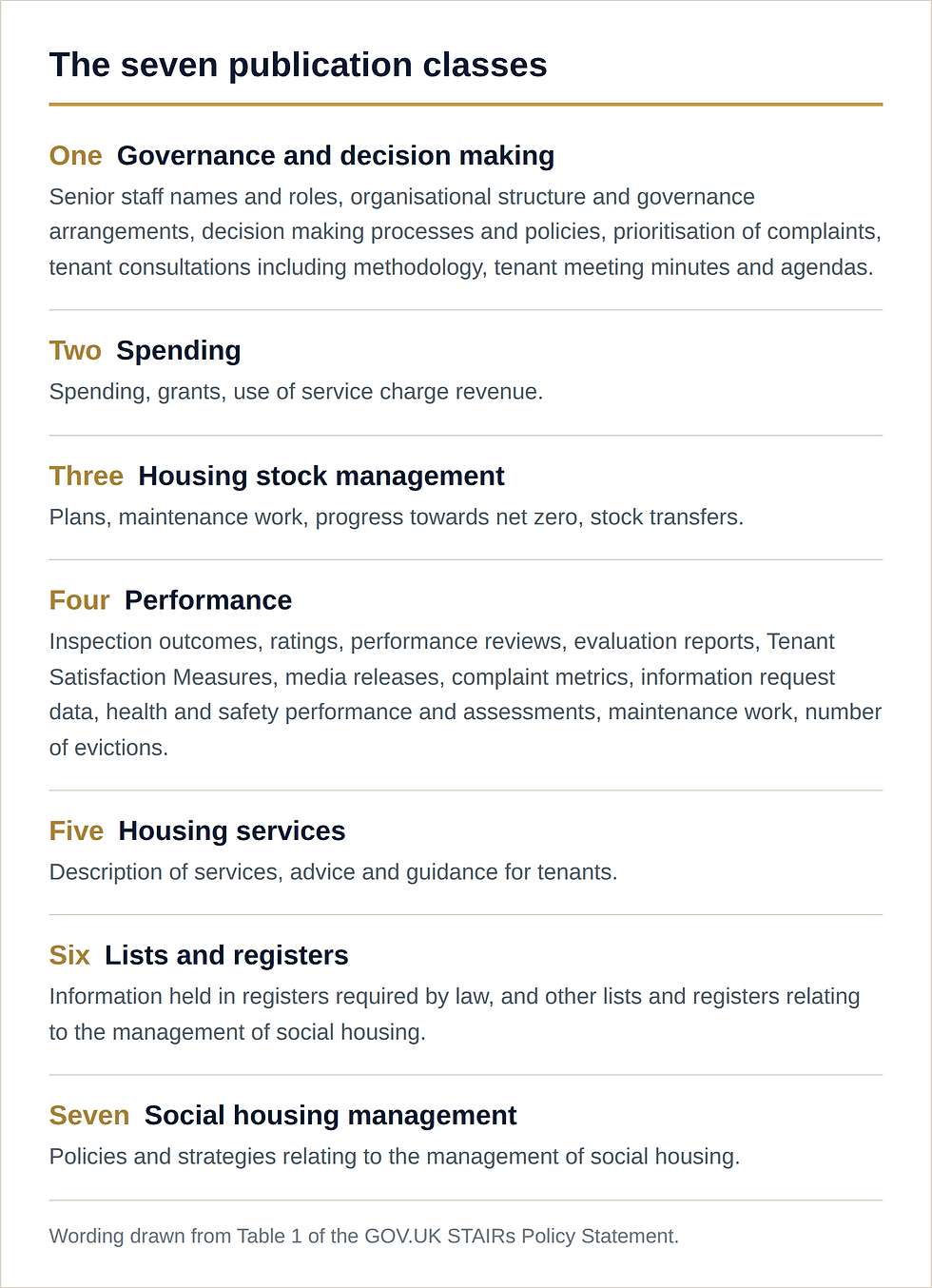
The publication duty covers information falling within seven classes. Between them they reach most of what an organisation holds about running its homes. Not all of it, but more than most people assume on a first read.
This is a records question before it's a website question
Most of the conversations I've had about STAIRs start with where things get published. That's the last question, not the first.
The first question is whether anyone can produce a single list of what the organisation holds that falls within those seven classes. Not what it should hold. What it does hold, where it sits, and who looks after it.
Almost everyone I've met in this sector is trying to get this right, and the ones furthest ahead are the ones who started with the filing rather than the front end. You can't publish what you can't find, and from April 2027 you can't send it to someone in 30 days either.
The second question is who owns each piece. A class doesn't become a task until someone's name is against it, and duties without an owner have a way of surviving right up until the deadline.
One thing the Policy Statement doesn't say
It doesn't say what level publication happens at. Whole organisation, region, scheme, building: the document is silent.
That silence is worth noticing rather than filling in. The duty sits on the provider, which reads as organisational. But some of the seven classes only mean anything scheme by scheme, because a group-level description of housing services doesn't describe what anyone actually receives.
Where complaints go
The Housing Ombudsman is the complaints body for STAIRs. It published a revised Scheme in July 2026, taking effect on 1 October 2026, which builds STAIRs in as a separate process from its existing complaints service.
There's a three month deadline for bringing a STAIRs complaint to the Ombudsman.
If you're reading this as a resident
What you can see, what you can ask for, and who to go to.
What you can do, and when
From 1 October 2026, your landlord publishes a set of information about how it runs its homes. You don't have to ask for it or explain why you want it. It's there to read.
From 1 April 2027, you can ask for information directly, and your landlord has 30 calendar days to answer.
Whether it covers you
You're covered if you rent from a housing association or another private registered provider. You're also covered if you're a shared owner and you own less than 100% of the equity in your home.
You're not covered if you rent from a council. That doesn't leave you with nothing: the Freedom of Information Act applies to local authorities and does a comparable job.
You're not covered if you're a leaseholder who isn't a shared owner. The published consultation response says that directly.
What the information covers
The seven classes are broad. Between them they reach how decisions get made, what money is spent on, how the homes are managed, how well the landlord is performing, what services you receive, and the lists and registers the landlord keeps.
If you've ever wanted to know why a cost appears on your statement, or what the arrangement is for something on your estate, that's the sort of question these requirements exist for.
If it goes wrong
The Housing Ombudsman handles STAIRs complaints, under its revised Scheme from 1 October 2026. There's a three month window for bringing one.
The two questions nobody has answered
Every guide has a section where the honest answer is "this isn't settled."
Here's ours.
What happens when a shared owner reaches 100%?
The definition says "less than 100% of the property equity." Buy the final share, and you fall outside the wording. I've checked the Policy Statement, the consultation response and the Housing Ombudsman's response, and I can't find anything that picks that person back up within the scheme.
The practical effect is that the group covered isn't a fixed list. It moves every time someone buys the last slice of their own home, and it's the landlord selling it. A provider could publish a compliant scheme in October and have changed its own covered population by Christmas, one final staircasing at a time.
To be clear about what this does and doesn't mean: the 2024 Act service charge provisions are a separate regime and they're not what's in question here. What changes at 100% is the STAIRs position specifically.
At what level does publication happen?
As above. The document doesn't say, and reading a requirement into a silence is how people end up doing work that was never asked for.
If either of these has been answered somewhere I haven't looked, I'd genuinely like to know. I'd rather be corrected in August than in October.

Are you reform ready?
Check with our free readiness tool covering both STAIRs dates, and the 2024 Act service charge measures. No registration, and your answers stay in your browser.
Information from published GOV.UK sources and the Housing Ombudsman. Not legal advice.
Sources: STAIRs Policy Statement (GOV.UK) · STAIRs consultation response (GOV.UK) · Housing Ombudsman Scheme and consultation response, July 2026
Comments